Factory Direct Engineering
Featured Interior & Transition Aluminum Systems
Explore our rigorously tested aluminum door configurations, spanning slim-profile acoustic glass partitions, dual-action slide-and-swing mechanics, and heavy-duty structural profiles tailored to international architectural standards.
Storefront / Pivot Series
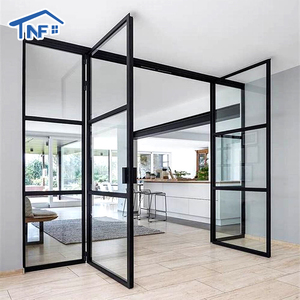
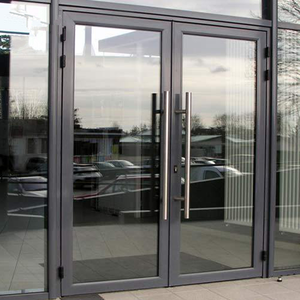
Modern Aluminum Glass Double Swing Casement Storefront Commercial Outdoor Patio Entrance Doors
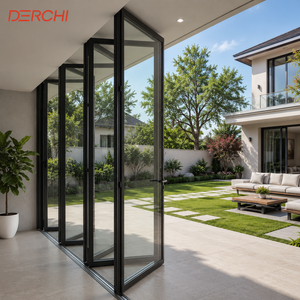
Bifold Internal Dividing
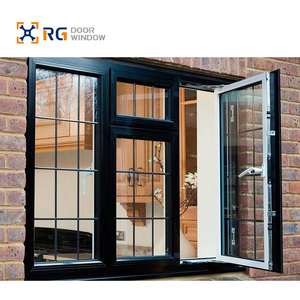
12 Feet Air Tightness Aluminum Tempered Glass Patio Accordion Folding Doors
180,000m²
Manufacturing Infrastructure
25+ Years
Industrial Engineering History
100+
Proprietary National Patents
18,000+
Completed Projects Worldwide
Procurement White Paper
Evaluating the Architectural Shift to Aluminum Internal Doors
Technical analysis of modern building materials: Why commercial developers and custom homebuilders are substituting traditional wood and hollow-core doors with aluminum-frame glazed assemblies.
In contemporary commercial architecture and high-end residential engineering, the internal door has evolved from a simple acoustic barrier into a high-performance structural component. Historically, interior space division relied on solid timber, engineered MDF, or standard hollow-core leaf assemblies. However, dynamic lifecycle assessments (LCA) demonstrate that conventional wood products face systematic vulnerabilities: moisture-induced warping, hygroscopic expansion, structural fatigue in tropical or high-humidity zones, and deteriorating acoustic performance over multi-year cycles.
This reality has driven a widespread industry transition toward extruded architectural aluminum interior doors. Fabricated predominantly from primary-billet 6063-T5 and 6063-T6 aluminum alloys, modern internal metal doors deliver structural integrity that traditional millwork cannot replicate. With ultimate tensile strengths exceeding 205 MPa and yielding thresholds past 170 MPa, aluminum internal door assemblies facilitate ultra-slim sightlines (often sub-25mm frame profiles) while structurally supporting oversized single-lite laminated tempered glass panels that weigh over 90 kilograms per sash.
Furthermore, internal aluminum door solutions directly resolve building physics requirements, including sound transmission class ratings (STC) and smoke perimeter sealing. By integrating hollow-core multi-chamber profile extrusions, composite thermal-break polyamide barriers (PA66GF25), and dual-perimeter ethylene propylene diene monomer (EPDM) synthetic rubber weatherstripping, aluminum doors mitigate flanking sound paths. When engineered in conjunction with acoustic PVB-laminated double glazing, these systems achieve laboratory-verified sound reduction values exceeding 38 dB to 42 dB—a vital metric for executive boardrooms, hospitality suites, healthcare environments, and contemporary urban condominiums.
Dimensional Stability & Moisture Immunity
Unlike engineered timber or composite polymer cores, aluminum frames exhibit zero moisture absorption and minimal thermal linear coefficient expansion. They remain plumb and square within dry-wall and masonry rough openings permanently, eliminating latch binding in high-humidity laundry, kitchen, and ensuite environments.
Patented Multi-Point Locking Integration
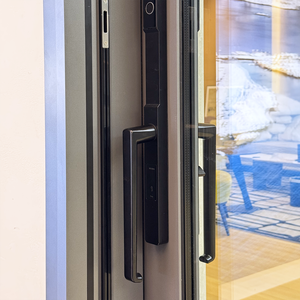
Internal partition access demands reliable hardware operation. DERCHI systems utilize proprietary four-side multi-point mechanisms along with European standard groove channels (Euro-Groove C-channel), enabling concealed pivot hinges, magnetic mortise latches, and silent flush drop-seals.
Life-Cycle Cost & ESG Compliance
Anodized and Qualicoat-certified fluorocarbon (PVDF) surface treatments deliver lifelong resistance to scratch, chemical cleaners, and UV yellowing. Aluminum is 100% infinitely recyclable without material property degradation, scoring high points on LEED v4 and BREEAM sustainability matrixes.
Market Forecast 2026–2030
Future Procurement & Product Development Trends
Strategic intelligence for general contractors, architectural specifiers, and wholesale dealers navigating technical requirements in commercial and residential interior hardware.
1. Micro-Profile Minimalist Sightlines
The global interior design landscape is transitioning from bulky frames toward monolithic, frameless glass aesthetics. Next-generation aluminum internal doors feature ultra-slim stiles ranging from 16mm to 20mm. These systems rely on structural corner key crimping, internal high-modulus polyurethane bonding, and tempered fluted/reeded glass to achieve architectural minimalism without compromising torsional stiffness.
2. Smart Building & IoT Access Integration
Procurement schedules increasingly demand invisible smart lock technology embedded directly within interior aluminum profiles. Emerging designs feature integrated magnetic latch bolts, biometric sensors integrated into pull handles, concealed electromagnetic transfers, and dry-contact relays compatible with commercial Control4, Crestron, and KNX building automation protocols.
3. Hybrid Slide-and-Swing Kinematics
In urban high-density developments across North America, Europe, and Asia, usable square footage commands a significant premium. Traditional swing doors consume up to 1.5 square meters of clearance arc. The rising demand for hybrid PD/PT (Slide-and-Swing) systems delivers a 180-degree flush opening that functions without floor guide tracks, creating barrier-free ADA-compliant layouts across narrow interior corridors.
| Performance Specification | Commercial Grade (Class A) | High-End Residential Grade | DERCHI Proprietary Benchmark |
|---|---|---|---|
| Alloy Base & Wall Thickness | 6063-T5 / 1.4mm – 1.8mm | 6063-T5 / 1.2mm – 1.4mm | Virgin 6063-T6 / 1.8mm – 2.2mm |
| Acoustic Rating (STC / Rw) | STC 30 – 34 dB | STC 28 – 32 dB | STC 38 – 42 dB (Acoustic Glazing) |
| Corner Joint Assembly | Mechanical Screw Cleat | Crimped Corner Key | Cast-Aluminum Hydraulic Crimped + Dual Glue Inject |
| Surface Coating Spec | AAMA 2603 Powder Coat | AAMA 2604 Fluoropolymer | Qualicoat Class 2 / PVDF 3-Coat / AkzoNobel |
| Locking Security Mechanics | Single-Point Magnetic Latch | Two-Point Hook Lock | Patented 4-Side 6-Point Multi-Point System |
Manufacturing Authority
Direct Factory Advantages: Guangdong Dejiyoupin Doors and Windows Co., Ltd.
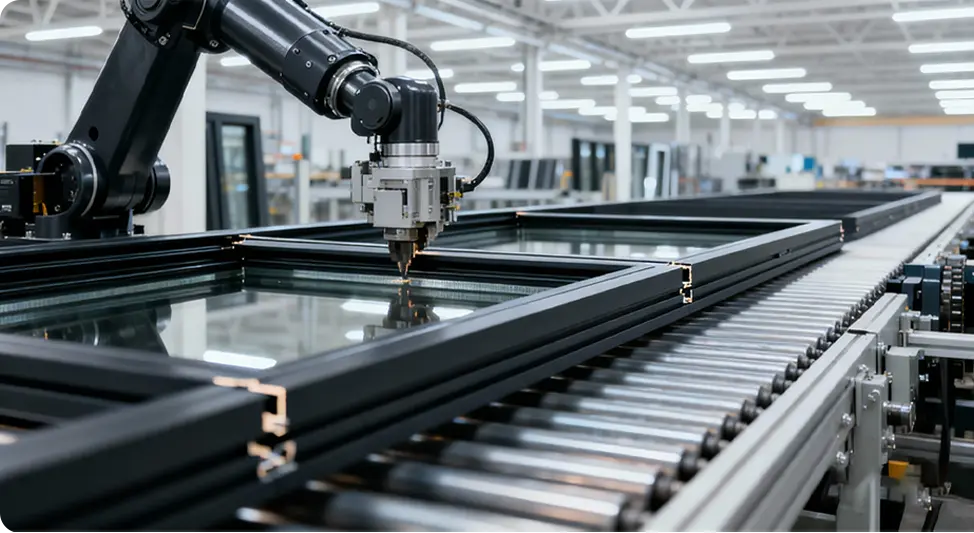
Operating under the internationally registered brand DERCHI, our enterprise is recognized as a leader in bespoke fenestration and interior architectural door fabrication. Awarded the prestigious "China Famous Brand" recognition by Xinhua News Agency, DERCHI pairs 25+ years of craft mastery with an automated Industry 4.0 production framework.
For North American, European, and Oceanian project managers, sourcing directly from DERCHI eliminates broker friction. We provide certified structural CAD reviews, imperial/metric shop drawings, precise rough-opening coordination, and laboratory-verified compliance documents across every order.
- 180,000 m² Integrated Campus: Annual capacity surpassing 1,000,000 m² guarantees strict construction schedule deadlines.
- Full International Code Testing: Active certifications including NFRC (US), CSA (Canada), ENERGY STAR®, CE, and ISO 9001.
- Proprietary IP Portfolio: Over 100 invention and utility patents, including our signature four-side multi-point locking assembly.
- 360° Quality Control Protocol: 100% dry-fit pre-assembly in our workshop prior to ocean-freight steel crating.


Procurement Guidance
Frequently Asked Questions by Specifiers & Buyers
Clear technical insights regarding engineering tolerances, rough opening accommodations, acoustic ratings, and international freight for interior aluminum systems.
What are the key differences between primary 6063-T5/T6 aluminum and recycled scrap alloys in door production?
Primary billet 6063 aluminum has precisely controlled chemical compositions, with strictly defined magnesium and silicon balances. This yields uniform grain alignment upon extrusion, superior surface smoothness for architectural anodizing or powder coating, and exceptional structural ductility. Secondary or low-grade recycled scrap alloys frequently contain iron impurities that lead to micro-fissures during corner crimping, uneven anodized oxidation, and structural deflection under heavy glass dead-loads. DERCHI uses only virgin 6063-T5/T6 extrusions with minimum wall thicknesses of 1.4mm to 2.2mm for all structural internal door profiles.
How do aluminum internal doors achieve high sound transmission class (STC) ratings without bulky frames?
Acoustic decoupling is achieved through a multi-faceted approach: multi-chamber internal hollow profile extrusions that disrupt airborne sound waves; continuous co-extruded EPDM foam gaskets around all three jamb contact surfaces; and automatic mechanical drop-down perimeter seals at the bottom sash that engage silently upon door closure. When paired with asymmetric laminated safety glass (e.g., 5mm glass + 0.76mm acoustic PVB + 5mm glass or double-glazed insulated units), our systems consistently test between STC 36 and STC 42, delivering verified acoustic isolation for boardrooms and master bedroom suites.
Can internal aluminum doors be manufactured to custom imperial rough openings and irregular wall thicknesses?
Yes. Every unit manufactured by Guangdong Dejiyoupin Doors and Windows Co., Ltd. is completely custom-engineered to project architectural schedules. Our technical engineering division produces complete submittal shop drawings accommodating imperial dimensions down to 1/16th of an inch. Furthermore, our frame systems offer adjustable two-piece telescoping architraves and casing extensions that sleeve directly over variable finished wall thicknesses—ranging from 90mm drywall partitions to 250mm solid concrete block structures—without requiring on-site shimming or casing retrofits.
What surface finish options are recommended for high-traffic commercial or coastal internal environments?
For high-traffic commercial interiors or coastal settings, we specify either Qualicoat Class 2 electrostatically applied thermosetting powder coatings (using AkzoNobel or PPG powders) or architectural Class I anodized finishes (18–25 microns). These finishes resist wear from cleaning agents, prevent chemical finger-marking, and eliminate chipping or micro-peeling. For projects requiring the warmth of timber with the structural stability of metal, DERCHI offers vacuum heat-transfer sublimated wood-grain finishes that provide tactile wood textures while remaining impervious to moisture and insects.
How are fragile glass assemblies protected during overseas containerized shipping?
All doors undergo initial pre-assembly and precision testing at the factory. Once approved, profiles and glass assemblies are protected using multi-layer peelable PE protective films, high-density edge guards, and shock-absorbing EPE foam wraps. The panels are then secured inside heat-treated, fumigated ISPM-15 plywood crates reinforced with interior perimeter strapping and steel bands. Every container loading layout is mathematically modeled via 3D packaging software to balance center-of-gravity weights, prevent in-transit shifting, and streamline staging at job sites across the United States, Canada, and global destinations.
Ready to review engineering submittals, testing matrices, or wholesale price schedules for your upcoming development?
Get Catalog