Engineered Fenestration & Structural Solutions
Explore our export-certified architectural window assemblies, precision aluminum extrusions, and specialized building components engineered for industrial, residential, and commercial developments.
Executive Technical Whitepaper: Global Sourcing Paradigms for Aluminum Fenestration
As international construction envelopes migrate toward net-zero operational footprints, procurement engineers, commercial developers, and project architects face intensified demands for fenestration solutions that combine superior mechanical durability with uncompromising thermal insulation. In contemporary high-rise developments, luxury residential complexes, and mixed-use commercial projects, window systems are no longer regarded simply as architectural apertures; they function as primary building envelopes that govern solar heat gain coefficients (SHGC), total visual transmittance, structural deflection tolerance, and acoustic attenuation metrics.
China has long anchored the global supply chain for precision-extruded aluminum alloys. However, the operational matrix of leading manufacturers has evolved from standard profile extrusion to integrated systems engineering. Modern supply agreements hinge upon comprehensive verification of raw material purity (such as 6063-T5 and 6063-T6 architectural grades), high-precision polyamide (PA66 GF25) thermal barrier integration, and certified robotic CNC miter and crimping operations. These processes ensure absolute water-tightness, wind pressure resistance reaching super-typhoon standards, and verifiable structural compliance aligned with North American NAFS (AAMA/WDMA/CSA 101/I.S.2/A440), NFRC thermal metrics, and European CE/EN directives.
Procurement teams must evaluate manufacturers beyond primary bill-of-materials pricing. Total cost of ownership encompasses long-term weather-seal retention, mechanical cycling integrity across thousands of actuations, and supply chain visibility from raw ingot melting to site-ready protective packaging. In this rigorous operating landscape, choosing an experienced, vertically integrated Chinese partner drastically minimizes schedule risks while optimizing structural safety.
Emerging Architecture & Procurement Trends (2025–2030)
Strategic purchasing managers must identify technological shifts before issuing tenders. The global fenestration market is undergoing seismic transformations driven by regulatory shifts and manufacturing capabilities:
Ultra-Narrow Sightlines with High Structural Load
Architectural preference heavily favors minimalist aesthetic frameworks where visible frame sightlines are reduced to under 30mm without compromising inertia against positive and negative wind pressures. This necessitates high-wall-thickness multi-chamber extrusions bolstered by concealed interior structural steel or titanium-alloy reinforcements.
Passive-House Envelope Standards (U ≤ 0.8 W/m²K)
Driven by escalating energy costs and regional zero-carbon mandates, fenestration specs are shifting from double-pane Low-E assemblies to krypton- or argon-filled triple-glazed units featuring warm-edge spacers, advanced multi-layer silver coatings, and multi-cavity polyamide thermal breaks exceeding 34mm in structural depth.
Four-Side Multi-Point Compression Hardware
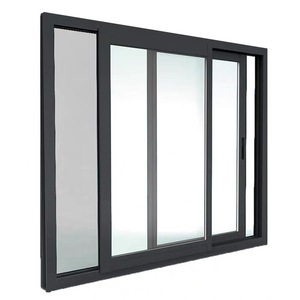
Traditional sliding systems rely on simple latching mechanisms vulnerable to air infiltration and forced entry. Next-generation systems feature multi-point circumferential locking gearboxes and lift-and-slide kinematics that mechanically compress continuous EPDM perimeter gaskets into precision frame rebates during closing.
Enterprise Manufacturing Advantages: Industrialized Precision
Operating as a world-class manufacturing authority under Guangdong Dejiyoupin Doors and Windows Co., Ltd. (operating the premier DERCHI brand), our production methodology bridges foundational metallurgical mastery with digitalized Industry 4.0 fabrication:
180,000 m² Automated Hub
High-capacity manufacturing infrastructure with automated high-speed cutting saws, CNC multi-axis milling machining centers, and automated glass bonding stations ensuring rapid, zero-deviation project cycles.
100+ Patents & Locking Tech
Pioneering mechanical solutions, including our nationally recognized four-side six-point lock invention patent designed specifically for extreme anti-pry, high-altitude wind-load, and forced-entry deterrence.
360-Degree Quality Matrix
Systematic inspection protocol monitoring raw ingot composition, anodizing/fluorocarbon coating micron thickness, corner joint mechanical crimp pull-strengths, and hermetic insulated glass seal integrity.
Comprehensive Compliance
Pre-engineered and tested in accordance with strict North American NFRC, Canadian CSA, ENERGY STAR, Florida Hurricane Impact standards, AS2047, and European CE industrial norms for verified specification compliance.
Buyer's Technical Evaluation & Global Procurement FAQ
Direct technical answers addressing engineering constraints, international shipping standards, and logistical compliance for volume importers, general contractors, and structural consultants:
What alloy compositions and thermal barrier technologies are utilized in heavy commercial specifications?
Our standard architectural extrusions leverage primary 6063-T5 or 6063-T6 aluminum alloys, exhibiting tensile strengths exceeding 205 MPa and yield strengths beyond 180 MPa. For extreme coastal and seismic requirements, we supply structural 6061-T6 profiles. For thermal insulation, our systems incorporate multi-cavity polyamide PA66 reinforced with 25% glass fiber (PA66 GF25), chemically crimped into dedicated frame cavities to maintain structural rigidity while preventing thermal bridging, surface condensation, and unwanted conduction in high-temperature or sub-zero environments.
How do your products achieve compliance with North American NAFS and Florida Hurricane Impact testing?
Our hurricane-resistant assemblies incorporate laminated impact glass featuring structural SentryGlas (SGP) or specialized poly-vinyl butyral (PVB) interlayers bonded directly within multi-point structural silicone rebates. Frames are reinforced with internal cold-rolled galvanized steel inserts along primary mullions. Completed mockups undergo severe large missile impact testing (Level D and Level E cycles) and cyclic pressure sequences up to +/- 90 PSF, satisfying Florida Product Approvals and Miami-Dade County Protocols (TAS 201, 202, 203) alongside baseline ASTM E1886 and ASTM E1996 standards.
What measures prevent transit damage, glass delamination, and frame oxidation during ocean freight?
All finished products undergo a multi-tiered protective packaging protocol. Finished aluminum profiles are shielded with custom 0.08mm electrostatic PE protective film and wrapped with waterproof EPE foam. Corner blocks are fitted with rigid impact-resistant ABS guards. Units are loaded into fully enclosed, fumigated solid-timber crates with integrated moisture-absorbing desiccant matrices to counteract container sweat and maritime salinity during transoceanic shipping. Furthermore, specialized steel internal A-frames are utilized for oversized sliding panels to eliminate flex cracking during transit.
Can profiles be customized for regional architectural rough openings, specialized hardware, and dual-tone finishes?
Yes. Every batch order is executed via detailed shop-drawing coordination. Our in-house technical engineering team works from CAD/BIM architectural files to accommodate imperial framing dimensions, rough opening tolerances, thermal break positions, sub-cill weep channels, and custom perimeter receptor systems. Finish customization includes Qualicoat-certified architectural powder coating, dual-color electrostatic paint (varying interior/exterior finishes), and AAMA 2605-grade PVDF (fluorocarbon) applications guaranteed against fading, chalking, and UV degradation for up to 25 years.