China has a broad network of aluminum door manufacturers, serving residential, commercial, and renovation projects. Their offerings range from slim-framed patio doors to insulated entry systems and customized sliding units. Yet a polished catalog does not tell the whole story. Buyers need to look beyond appearance and compare frame construction, hardware, glazing options, finish quality, and production capabilities.
This guide to top aluminum door manufacturers in China explains what to assess before requesting a quotation. It considers product range, customization, quality-control practices, export experience, and the clarity of technical documentation. Details matter. A sample corner, for instance, can reveal how neatly profiles meet, while smooth hardware operation offers a practical clue about assembly. These observations are useful, but they do not replace factory audits or independent testing.
Reliable evaluation also means checking whether specifications match the intended climate, building design, and installation method. Ask for current test reports, material details, warranty terms, and customer references where available. Verify claims directly; capabilities can differ between factories, even when product photos look similar. This takes time. And no single supplier is ideal for every project. The comparison ahead aims to help readers identify promising partners, ask sharper questions, and balance cost with documented performance, communication, and after-sales support.
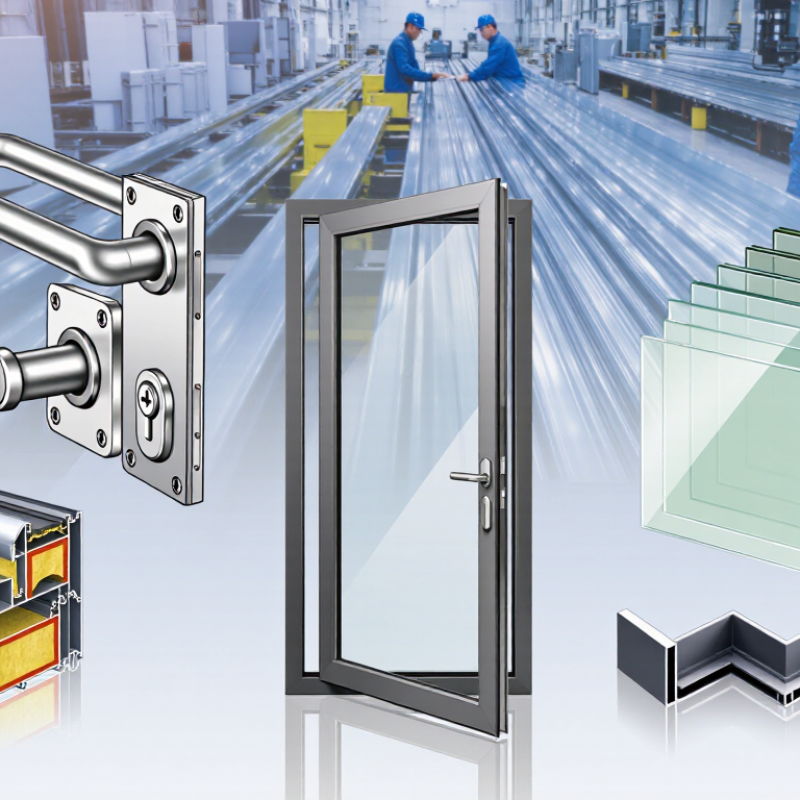
China’s aluminum door manufacturing industry combines metal processing, glass fabrication, hardware sourcing, and final assembly. Production is concentrated in industrial regions with access to extrusion suppliers and transport networks. This helps manufacturers handle both standard residential doors and customized commercial systems. The factory floor can reveal a lot: cut profiles, sealed corners, and neatly labeled hardware suggest an orderly process.
Good performance depends on more than a thick frame. Alloy choice, surface treatment, drainage design, and installation details all matter. A well-made door should close evenly, resist water at its joints, and move without scraping. Ask how the manufacturer checks dimensions and tests finished units. Small differences in gasket placement can become noticeable after a rainy season. Details matter.
The industry is capable, but quality is not uniform across every supplier or product line. A polished showroom sample may not represent routine production. Buyers should compare drawings, finish samples, packaging, and inspection records, then confirm that the delivered specification matches the approved sample. I would also leave room for practical judgment: paperwork helps, yet it cannot replace checking a real unit. Some projects still underestimate installation, where uneven openings can undermine even careful factory work.
Choosing among aluminum door manufacturers in China requires more than comparing catalog prices. Start with the profile specifications: alloy grade, wall thickness, surface finish, and corner-joint construction. Ask for a written bill of materials and check that the sample matches the production drawings. Small differences matter. A thinner frame may flex around a wide opening, while an uneven coating can show near the handles and hinges. Ask how the manufacturer checks dimensions, finish consistency, and hardware fit during production. Clear records are more useful than broad quality claims.
Evaluate performance evidence, not just appearance. Request test reports for relevant air leakage, water penetration, wind resistance, and thermal performance, and confirm which door configuration each report covers. A test on one model may not represent a different size or glass arrangement. Review packaging details too: corner guards, moisture protection, and loading photos can help reduce damage during shipping. Factory audits or live production checks can clarify how samples, inspection records, and corrective actions are handled. No supplier is flawless; the important question is how issues are documented and resolved.
Tips: Send the same drawings and questions to each candidate. Compare lead times, warranty terms, spare-part availability, and inspection steps in writing. If a reply is vague, ask for a specific example or record. Keep one concern in mind: the cheapest quote can still be the expensive choice if specifications drift after approval.
Profiles of notable aluminum door manufacturers in China are best compared by capability, not publicity. Integrated producers manage extrusion, thermal-break assembly, surface finishing, and hardware fitting. This can improve process consistency, but buyers should inspect sample corners, drainage slots, and coating thickness. Project-focused fabricators handle nonstandard openings and coordinate closely with installers. Export-oriented factories often provide detailed specifications and protective packaging; export experience alone does not prove product performance.
Scale is substantial: the USGS Mineral Commodity Summaries 2024 estimates China produced about 41 million tonnes of primary aluminum in 2023, out of roughly 70 million tonnes worldwide. This measures upstream metal, not door production or quality. The International Aluminium Institute reports that about 75% of all aluminum ever produced remains in use, making durability and repairability important considerations. Yet frame lifespan also depends on seals, hardware, finish, and local exposure.
Tips: Request test reports for the exact quoted configuration. Check gasket compression, corner alignment, drainage, and spare-part availability. Small details matter.
China’s scale gives door manufacturers broad access to aluminum profiles, but raw-material output does not measure finished-product quality. The USGS Mineral Commodity Summaries 2025 estimates China produced 43 million metric tons of primary aluminum in 2024. Global output was about 72 million tonnes, putting China near 60%. That figure describes metal, not finished doors. Compare thermal-break profiles, glazing options, drainage design, hardware, and coating durability. Small details count.
Factory capability shows in tooling control, assembly consistency, and documented inspection. Ask for profile drawings, hardware specifications, coating details, and a sample matching the intended order. Certifications need careful reading. ISO 9001 addresses quality systems, while ISO 14001 covers environmental management; neither alone proves door performance. For export projects, request test reports against relevant requirements, such as EN 14351-1 in Europe or NFRC-rated energy data in the United States. Requirements differ by market. Check the report’s scope, laboratory, product size, and date. A common weakness is accepting a certificate without confirming that its tested configuration matches the doors being purchased.
Choosing a Chinese aluminum door manufacturer requires more than comparing quoted prices. Ask for project references, production capacity, and clear drawings before discussing a large order. A reliable supplier should explain alloy specifications, profile dimensions, thermal-break design, and available surface finishes in plain language. Vague answers matter.
Request a sample corner or full-size unit when practical. Check how smoothly the door operates, whether the frame corners align, and how the seals meet at the threshold. Ask for coating and hardware details, plus test reports that match your intended climate and use. A coastal site, for example, may need different corrosion protection than an inland home. I would not treat a brochure as proof.
Confirm how measurements, packaging, shipping, and replacement parts are handled. Get production timelines and inspection points in writing, then compare them with your installation schedule. Video calls can help, but they cannot replace a careful review of samples or an independent factory inspection for a substantial purchase. This step can feel inconvenient. It is still easy to overlook small details, such as drainage paths or handle placement, until installation makes them costly.
Alloy, frame thickness, surface treatment, drainage, and installation all matter. A thick frame alone proves little.
Look at sealed corners, even finishes, and neatly fitted hardware. Details matter.
Request profile details, drawings, and a written bill of materials. Check that the sample matches the approved design.
Ask for reports on air leakage, water penetration, wind resistance, and thermal performance. Confirm each report covers the exact door configuration.
No. Routine production may differ. Compare samples with inspection records and, where possible, check a real unit.
Check for corner guards, moisture protection, and loading photos. A scraped frame can still arrive.
Uneven openings can affect movement and sealing, even with careful factory work. This is easy to underestimate.
Not always. Compare lead times, warranty terms, spare parts, and inspection steps in writing. I would still leave room for judgment.
China’s aluminum door manufacturing industry has developed into a broad and competitive sector, serving residential, commercial, and architectural projects. Leading manufacturers can be assessed by the quality and consistency of their materials, production capacity, design options, customization services, delivery reliability, and after-sales support. Product range matters too: buyers may compare thermal performance, sound insulation, weather resistance, hardware options, finishes, and suitability for different building requirements.
A careful comparison should also consider manufacturing processes, quality-control procedures, relevant certifications, and a supplier’s ability to provide clear technical documentation. When selecting a Chinese Aluminum Door manufacturer, define project specifications and budget first, then review product samples, confirm customization and lead times, and evaluate communication and service capabilities. This approach helps buyers identify a dependable supplier whose products and production strengths align with the project’s needs.